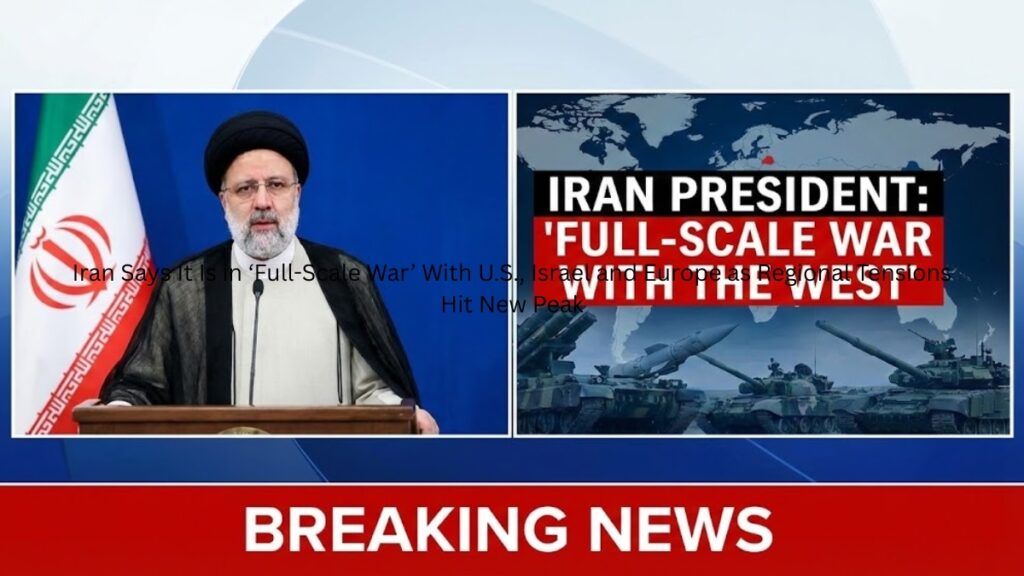
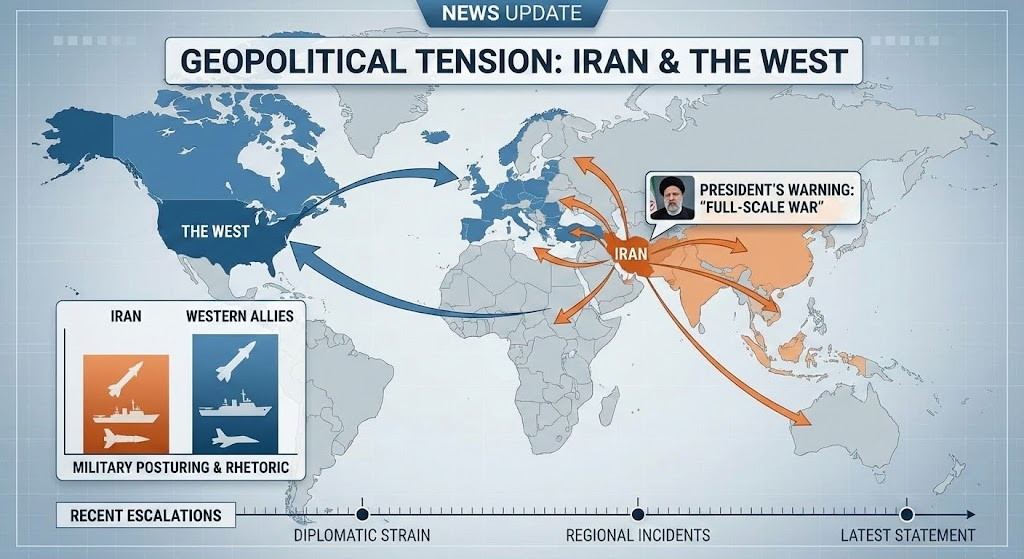
Tehran, December 29, 2025 — Iranian President Masoud Pezeshkian declared his country to be in a “full-scale war” with the United States, Israel and European powers, in remarks that dramatically escalate rhetoric in an already volatile region.
The comments come at a moment of intense diplomatic and military tension, with major world leaders preparing for high-stakes talks on Iran’s nuclear program and regional security.
In an interview published on the official website of Supreme Leader Ayatollah Ali Khamenei, Pezeshkian said Tehran faces not a limited confrontation but a comprehensive conflict across military, economic and cultural fronts.
“In my opinion, we are in a full-scale war with the United States, Israel and Europe,” he said, adding that Western powers were trying to prevent Iran from “standing on its feet.”
The remarks represent the most expansive public articulation yet of how the Iranian leadership perceives its struggle with Western nations. They signal not only deepening hostility but a reshaping of Tehran’s strategic narrative, which frames sanctions, military actions and diplomatic pressure as parts of a united campaign to weaken Iran.
From Ceasefire to Escalation
This escalation follows a fraught year in which Iran’s confrontation with Israel and the United States moved beyond proxy conflicts to direct military engagement. In June 2025, a 12-day war between Israel and Iran erupted after Israeli strikes targeted Iranian military and nuclear facilities.
Iranian authorities reported nearly 1,100 deaths, including senior commanders and nuclear experts, while Iranian missile counterattacks killed dozens in Israel. A ceasefire eventually took hold in late June, mediated by Qatar and the United States.
Despite the ceasefire, tensions have not dissipated. U.S. forces conducted strikes on Iranian nuclear sites during the conflict, and the negotiation window for reviving the 2015 Iran nuclear deal remains closed. European powers led efforts to reimpose United Nations sanctions in response to Iran’s nuclear enrichment activities, drawing Tehran’s ire.
In this context, Pezeshkian’s choice of language — invoking the concept of “full-scale war” — reflects mounting frustration in Tehran over its international isolation and economic struggles, including declining oil revenues, sanctions pressure and rising inflation. Analysts say his declaration aims to solidify domestic unity while warning adversaries that Iran will not back down.
What ‘Full-Scale War’ Means in Tehran’s View
When Pezeshkian refers to war, he is not necessarily predicting immediate large-scale conventional battles between armies. Instead, his administration views current hostilities as multidimensional: encompassing military engagements, economic sanctions, diplomatic isolation and cyber and informational fronts.
In a state media interview, he compared the current conflict to the brutal Iran-Iraq war of the 1980s, describing it as “more complicated and difficult.”
His government portrays sanctions, trade restrictions and global efforts to curb Iran’s nuclear program not as traditional warfare but as a coordinated assault aimed at crippling the nation.
Pezeshkian charged that Western actions make life harder economically and socially for ordinary Iranians — a strategy he says is designed to sow dissent and weaken the Islamic Republic.
Inside Iran, state media and officials are using the language of total conflict to rally support, urging unity among political factions and emphasizing Iran’s resilience. The president has also sought to assure the public of the Iran military’s strength, claiming that Tehran’s armed forces are in a better position now than they were during past confrontations.
Diplomatic Crossroads
The timing of Pezeshkian’s remarks is critical. They precede a scheduled meeting between Israeli Prime Minister Benjamin Netanyahu and U.S. President Donald Trump, where Iran’s behavior and nuclear ambitions are expected to dominate discussions.
Washington has signaled that it remains open to diplomacy but insists any talks must be meaningful and include verifiable limits on Tehran’s nuclear enrichment.
Trump’s government has revived what it calls a “maximum pressure” policy, re-imposing broad sanctions and empowering allies to curb Iran’s oil revenues. Tehran, for its part, rejects what it labels unlawful interference and insists that its nuclear program is peaceful. The sit-forward posture adopted by Tehran reflects a fundamental mistrust of Western intentions after decades of confrontation.
European actors, including France, Britain and Germany, have been particularly vocal on sanctions, arguing that Iran’s nuclear advances pose a threat to global security. Their stance has helped lead to renewed UN restrictions, which Iran sees as punitive and unjust.
Regional Repercussions
Beyond direct Western-Iranian tensions, the declaration has broader regional implications. Tehran has long been a central power broker in the Middle East, supporting allies and proxy forces across Lebanon, Syria, Iraq and Yemen.
Its relationships with groups like Hamas and Hezbollah complicate regional diplomacy and have historically drawn support from some states and condemnation from others.
The potential for flare-ups extends into the Gulf of Hormuz, a strategic chokepoint for global oil shipments. In late December, Iranian forces seized a foreign tanker in the Strait, detaining its crew and citing actions against smuggling.
Such maritime incidents add to worries about disruptions in global energy markets and the potential spillover of conflict into international shipping lanes.
Global Reactions
Globally, governments are watching with both alarm and caution. Western capitals have reiterated their support for sanctions and pressure tactics, but most have stopped short of calling Pezeshkian’s comments a formal declaration of war.
For many diplomats, the choice of rhetoric reflects Tehran’s attempt to shape world opinion and harden its negotiating position rather than signal a transition to open conflict. Analysts suggest that labeling current hostilities as “war” may be aimed at raising stakes ahead of critical diplomatic junctures.
Some experts caution that such language carries real risk. “When leaders publicly describe relations in terms of war, it narrows the room for compromise and increases the likelihood of missteps,” said a senior Middle East analyst. The concern is that even if neither side desires full conventional conflict, miscalculations, accidents or nationalist pressures could escalate tensions unintentionally.
Domestic Impact in Iran
For Iranians, Pezeshkian’s speech comes amid growing economic hardship. Sanctions have eroded purchasing power and limited access to international markets. Unemployment and inflation have become pressing political issues.
Tehran’s leadership is using the narrative of external aggression to deflect criticism and unify political factions from conservatives to moderates — all under a banner of resistance.
State-led media campaigns portray Western policies as existential threats, often highlighting historical grievances and past wars. This messaging resonates with portions of the population familiar with the devastation of the Iran-Iraq conflict, but it also fuels anxiety among citizens weary of prolonged economic strain and uncertain future prospects.
What Comes Next
As world leaders prepare for talks in Washington and beyond, several outcomes are possible:
- Diplomatic engagement could ease tensions if both sides find common ground on nuclear limits and sanctions relief.
- Continued pressure and retaliation may deepen confrontations, especially if regional proxy conflicts intensify.
- Accidental clashes between military forces or in hotspots like the Gulf of Hormuz could spark broader escalation.
The next few weeks will be pivotal. The narrative of war advanced by Pezeshkian may be intended as leverage, but it also raises the stakes for diplomacy and risks locking all parties into positions that make compromise harder.
Final Thoughts
Iran’s declaration of being in a full-scale war with the West underscores how deeply fractured relations have become. This framing combines military, economic and political dimensions into a single existential narrative for Tehran.
Whether this moment leads to renewed peace talks or further escalation will depend not only on state actions but on how global leaders and regional powers choose to respond to one of the most serious geopolitical flashpoints of the early 21st century.

Pet trainer with a passion for helping animals and owners build strong, loving bonds through positive reinforcement and expert care.