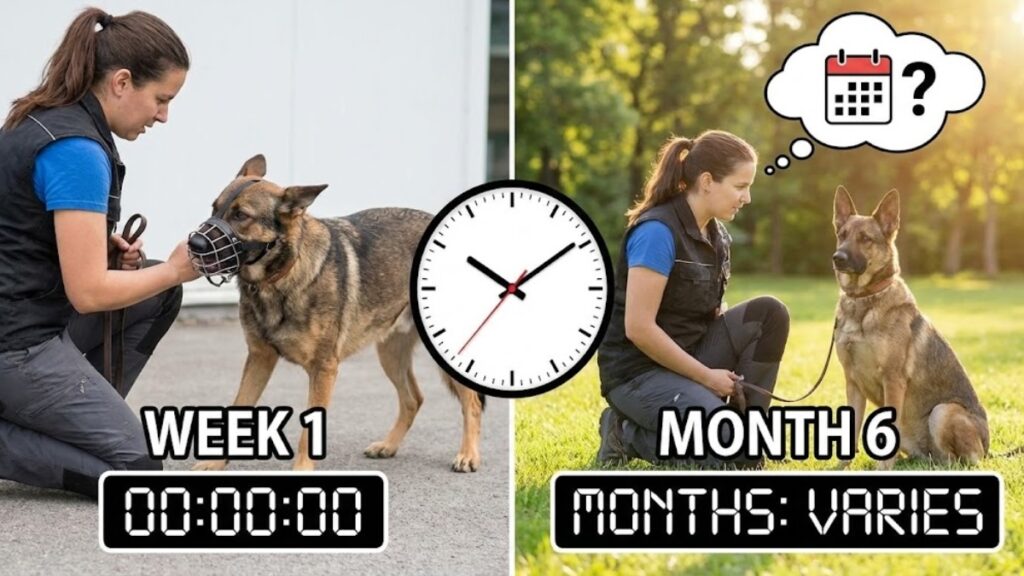
Every year, millions of families in the United States wake up to the alarming reality that their beloved pet dog has shown aggression, whether growling at visitors, lunging at joggers, or even biting a family member. As concern rises, many owners urgently ask, How Long Does It Take to Train an Aggressive Dog, hoping for a clear and quick solution.
In fact, it’s estimated that 4.5 to 4.7 million people are bitten by dogs annually in the U.S., with roughly 800,000 of those incidents requiring medical attention. Nearly half of bite victims are children under 12, many encountering aggression from a familiar household companion rather than a stray.
Rehabilitating an aggressive dog is rarely straightforward. Unlike teaching a simple “sit” command, aggression develops from a complex mix of emotional responses, past experiences, genetics, and environment.
Understanding How Long Does It Take to Train an Aggressive Dog requires realistic expectations, since there is no universal timeline. Each case demands a tailored approach grounded in behavior modification, canine psychology, and patience over weeks or months rather than days.
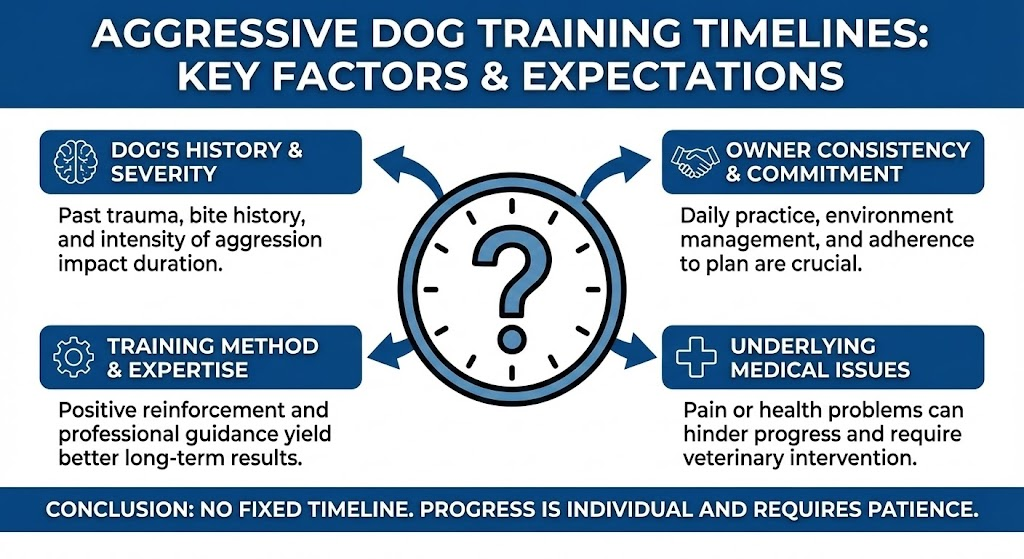
Why does training duration matter?
- Safety: Untreated aggression poses risks to humans, other animals, and the dog itself.
- Consistency: Owners who underestimate the time required often abandon protocols midstream, leading to setbacks.
- Expectations: Clear timelines foster owner engagement and reduce frustration.
- Legal considerations: In many jurisdictions, documented rehabilitation progress can influence liability rulings after a bite incident.
Understanding Canine Aggression
Common Types & Triggers
Fear-based aggression
- Triggers: Sudden noises, unfamiliar people or animals, startling movements.
- Signs: Cowering, lip-licking, avoidance escalating to growling or lunging.
Territorial aggression
- Triggers: Perceived invasion of “home turf”—front door, yard, or favorite resting spot.
- Signs: Barking at visitors, lunging at passersby through windows.
Dominance/assertive aggression
- Triggers: Resource guarding (food, toys), attempts to assert social rank.
- Signs: Growling when approached while eating, stiff posture, guarding behaviors.
Predatory aggression
- Triggers: Chasing small moving objects (cats, squirrels, joggers).
- Signs: Intense focus, silent stalking, pouncing without warning.
Underlying Causes
Genetics & breed predispositions
Certain breeds (e.g., herding or guard lines) may have heightened alertness or reactivity.
Early trauma or poor socialization
Puppies lacking positive exposures between 3–12 weeks may develop chronic fear or reactivity later in life.
Medical issues
Pain (dental, orthopedic), neurological disorders, or endocrine imbalances (e.g., thyroid dysfunction) can lower thresholds for aggression.
How Type & Cause Shape the Pace of Progress
A puppy with noise-startle reactivity may overcome fear-based aggression faster (2–3 months) through desensitization and counterconditioning, whereas a senior rescue dog with deep-seated resource guarding might require 6–12+ months of structured behavior modification. Aligning the rehab plan to the aggression’s root cause greatly influences the rehabilitation timeline.
Key Factors Influencing Training Duration
- Severity & frequency of episodes
- Dog’s age & developmental stage
- Breed tendencies & individual temperament
- Owner commitment
- Environment
- Positive reinforcement outperforms punishment-based approaches in long-term welfare and obedience.
- Professional involvement
How Long Does It Take to Train an Aggressive Dog?
Note: These timelines are averages based on professional consensus. Individual cases will vary.
Phase 1: Assessment & Planning (1–4 weeks)
- Behavioral evaluation by a certified trainer or veterinary behaviorist.
- Veterinary exam to eliminate pain or medical contributors.
- Baseline data collection: Incident logs, video analysis.
- SMART goal setting: Specific, Measurable, Achievable, Relevant, Time-bound.
Phase 2: Foundation Building (2–8 weeks)
- Trust exercises: Name games, approach-and-retreat activities.
- Basic obedience: “Sit,” “Stay,” “Leave-it” as safety anchors.
- Impulse-control games: Waiting at doorways, “Settle” mat work.
- Intro to mild desensitization.
- Progress tracking: Weekly reviews of logs and video.
Phase 3: Behavior Modification (3–12+ months)
- Counterconditioning: Pairing triggers with high-value rewards.
- Graduated exposure: Slowly decreasing distance to triggers.
- Reinforcement schedules: Fixed to variable.
- Generalization: Practicing commands in diverse locations.
- Setbacks management: For illness, weather, household changes.
Phase 4: Generalization & Maintenance (Ongoing)
- Booster sessions every 3–6 months.
- Controlled socialization.
- Long-term monitoring for regression.
Realistic Timelines by Aggression Level
| Aggression Level | Description | Average Duration | Notes |
| Mild | Fearful lunging, low-intensity | 2–3 months | Often resolves with basic desensitization & obedience. |
| Moderate | Occasional biting, high arousal | 4–6 months | Needs structured behavior modification & professional input. |
| Severe | Frequent biting, unpredictable | 6–12+ months (ongoing) | May require medication & lifelong management. |
| Resource Guarding | Growling/lunging over food/toys | 3–9 months | Follows trade-up & leave-it protocols. |
Real-World Case Studies & Success Stories
Case A: Fear Aggression Toward Strangers
- Baseline: Intense lunging at >10 ft.
- Protocol: Systematic desensitization and counterconditioning.
- Timeline: 8 months to calm greetings at 3 ft.
- Outcome: Dog now willingly approaches guests for treats.
Case B: Territorial Aggression in Multi-Dog Household
- Challenge: Growling over doorways and toys among three dogs.
- Protocol: Management via baby gates, individual “settle” mats, group feeding with graduated distance.
- Timeline: 6 months to shared access without conflict.
- Outcome: Dogs coexist peacefully; occasional refreshers maintain harmony.
Case C: Resource Guarding of Food & Toys
- Protocol: “Leave-it” exercises, trade-up games.
- Timeline: 5 months to reliable drop-on-cue and safe handling.
- Outcome: Dog drops bowl on command; no lunging when owner approaches.
Measuring Progress & Success
- Behavioral metrics: Incident frequency, display intensity.
- Training logs & video reviews.
- Scheduled re-evaluations every 4–8 weeks.
- Adjusting SMART goals.
Common Challenges & Pitfalls
- Owner burnout.
- Inconsistent reinforcement across family members.
- Overreliance on punishment, risking worsened aggression.
- Environmental setbacks: New baby, move, storms.
- Medical regressions.
When & How to Seek Professional Help
Red Flags Beyond DIY Scope
- Escalating bites.
- Unknown triggers.
- Self-injury or aggression toward handlers.
Types of Experts
- Certified Dog Trainers (CPDT-KA, CBCC-KA).
- Veterinary Behaviorists (DACVB).
- Applied Animal Behaviorists (CAAB).
What to Expect
- Costs: $100–$250 per session; specialized clinics may cost more.
- Session structure: 60–90 min initial; 30–60 min follow-ups.
- Safety protocols: Use of muzzles, barriers, sedation if needed.
Medication & Supplemental Therapies
- Anxiolytics: Fluoxetine, clomipramine.
- Pheromone diffusers.
- Dietary supplements: L-theanine, omega-3s.
Frequently Asked Questions
Can all aggressive dogs be fully rehabilitated?
Most dogs improve significantly, but lifelong management is often necessary.
How much does professional behavior therapy cost?
Initial consultations range $100–$250; follow-ups $75–$150.
When is rehoming a better option?
When aggression poses uncontrollable safety risks despite best efforts.
What if my dog regresses after a stressful event?
Increase management; return to last successful stage before resuming progress.
How do I know I’m making real progress?
Use quantitative tracking (incident logs, threshold distances) and schedule professional re-evaluations.
Maintenance Tips & Long-Term Management
- Avoid high-stress scenarios; use gradual exposure.
- Calming aids: Pheromone diffusers, anxiety wraps.
- Regular veterinary checkups.
- Quarterly booster training sessions.
- Daily enrichment activities: Puzzle toys, exercise, mental games.
Additional Resources & SEO Enhancements
Recommended Reading
- The Cautious Canine by Patricia McConnell
- Mine! A Practical Guide to Resource Guarding by Jean Donaldson
Online Support
- Reactive-Owners Facebook groups
- IAABC forums
Certifications to Look For
- CCPDT
- IAABC
- CBCC-KA
Conclusion
Rehabilitating an aggressive dog demands patience, consistency, and a long-term commitment. By understanding the underlying causes of aggression, tailoring a multi-phase behavior modification plan, and measuring progress with clear metrics, most dogs can learn to coexist safely with their families.
Rehabilitation is a journey, not a race—safety and welfare for both humans and dogs must remain the guiding stars. With the right tools, professional support, and unwavering dedication, you can transform aggression into trust, one step at a time.

Pet trainer with a passion for helping animals and owners build strong, loving bonds through positive reinforcement and expert care.