
New York
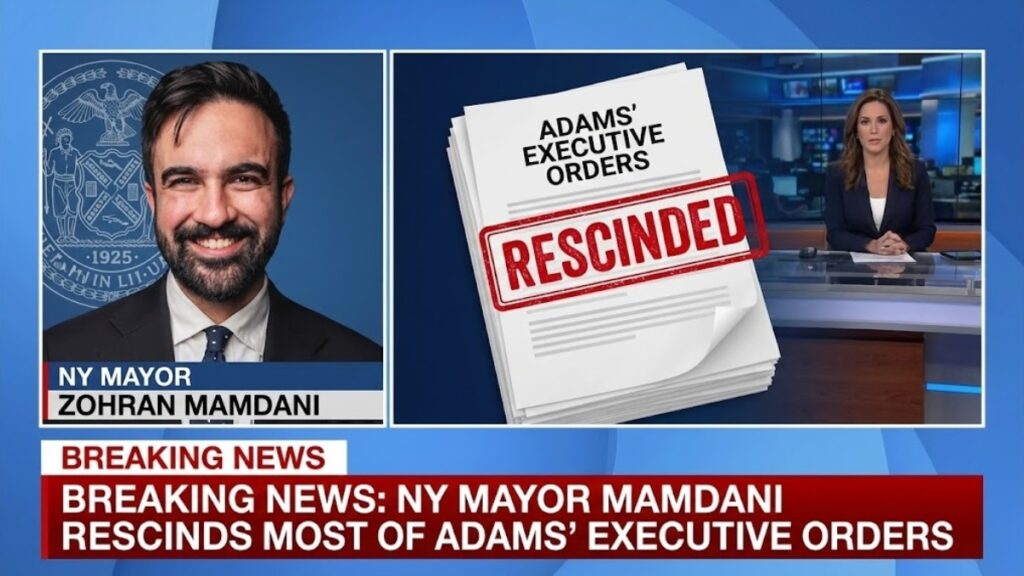
New York City’s newly inaugurated mayor, Zohran Mamdani, wasted no time reshaping municipal governance. Within hours of taking office on January 1, 2026, Mamdani signed a sweeping executive order rescinding the vast majority of executive orders issued by his predecessor, Eric Adams, after Adams was federally indicted in September 2024. The move is part of a broader effort by the new mayor to signal a fresh start for city administration and reset policy priorities under his Democratic Socialist agenda.
A “Fresh Start” for City Hall
Mamdani’s first executive order, Executive Order No. 01, nullifies all executive orders issued on or after September 26, 2024, the date former Mayor Eric Adams was indicted on federal corruption charges. The order specifies that executive orders issued before that date remain in effect unless specifically revoked, revised, or superseded by later actions. Emergency executive orders under state law are exempted.
The move was framed by Mamdani as a step toward restoring public trust in local government and resetting policy direction after a tumultuous period in City Hall. “We speak about this day as a new era,” Mamdani said at his inauguration, adding that confronting political disillusionment among New Yorkers was a priority.
What Was Revoked
The rescinded orders include a range of policies spanning from procedural directives to politically sensitive decisions. Among the notable actions reversed:
Antisemitism Policy Implementation
An executive order under Adams had put into place the International Holocaust Remembrance Alliance (IHRA) definition of antisemitism for city agencies, a measure that drew controversy for its inclusion of some forms of criticism of Israel. Mamdani’s revocation of this definition was widely reported and underscores a shift in how the city may approach speech and discrimination policy.
Anti-Boycott Policies
Adams issued orders opposing certain boycott campaigns, including restrictions on city contracting decisions that could be viewed as discriminatory against the State of Israel or people associated with it. Those orders were also rescinded.
Other Adams Directives
Independent reporting notes that orders related to immigration policy reviews, protest policy adjustments, and other administrative actions were undone or set aside by Mamdani’s executive order.
City officials say the move is intended to give Mamdani latitude to revisit policies with a fresh perspective and align them with his own policy agenda. While some rescinded items will not be reinstated, others may be reissued in modified forms under future orders.
What Is Being Kept or Modified
Not every Adams-era directive was eliminated. Mamdani explicitly stated his intention to preserve the Mayor’s Office to Combat Antisemitism, originally established under Adams. This office is tasked with monitoring and responding to antisemitic incidents across the city, a priority that crosses administrations despite political differences.
Mamdani also indicated that other measures, including certain protest policy guidelines, could remain in place with amendments rather than complete revocation.
Political and Cultural Context
The rescission of Adams’ executive orders comes amid an ongoing political realignment in New York City. Adams, a Democrat of more moderate political stance, faced federal indictment in late 2024 on corruption charges tied to allegations of accepting perks and contributions in exchange for political influence.
Although that case was later dismissed in April 2025, the episode sparked intense political debate in the city and contributed to a sharp decline in public confidence in Adams’ leadership.
Mamdani, by contrast, ran on a platform that emphasized tenant protections, housing affordability, and a break from establishment politics. His decisive cancellation of Adams’ post-indictment orders reflects not just a policy reset but also a symbolic rejection of his predecessor’s leadership and legacy.
Supporters have hailed the moves as necessary for accountability and responsiveness, while critics argue they risk administrative instability and politicization of governance tools.
Legal and Administrative Implications
The legal authority for a mayor to rescind prior executive orders stems from the broad executive powers vested in the office of the mayor under the city charter.
By setting a clear cutoff date tied to the former mayor’s indictment, Mamdani’s order invokes a rationale designed to limit disruption to long-standing city policies while addressing recent directives that he views as tainted or out of step with his administration’s goals.
However, the move introduces potential administrative complexities. Agencies that had been operating under Adams’ directives on civil rights enforcement, protest policing, housing policy, and related matters may now face uncertainty as to which policies govern their operations.
City attorneys and department heads will likely need to undertake detailed reviews to interpret the implications of the revocations and any subsequent policy replacements.
Public Reaction
Opinion in New York City is divided along familiar political lines:
- Progressive and Left-Leaning Groups: Advocates for tenants, civil liberties organizations, and left-wing activists generally support Mamdani’s aggressive reshaping of executive authority. They argue the rescissions help erase policies they viewed as favoring elite interests or suppressing dissent.
- Moderate and Conservative Voices: Critics have expressed concern that sweeping cancellations undermine stability in governance and could weaken protections for vulnerable populations, including Jewish communities and small business owners who supported some of Adams’ policies on hate crime definitions and civil order.
Several civil rights groups, including some advocating for Jewish communities, have called for clarity on how anti-discrimination and hate crime policies will be enforced in the wake of these changes.
What Comes Next
As Mamdani’s administration moves forward, analysts say several key developments will be critical to watch:
- Policy Replacement or Revision: Which rescinded orders might be replaced by new directives aligned with Mamdani’s agenda, and how quickly that happens.
- Legal Challenges: Whether rescissions provoke legal challenges or interpretations in city courts, particularly on civil rights and law enforcement policy.
- Administrative Transition: How city agencies adapt to the abrupt shift in policy framework and whether continuity in essential services is maintained.
Mamdani’s actions reflect his broader vision for New York City and signal an ambitious and rapid attempt to govern on his first day in office. Whether this approach yields lasting improvement or friction within the city government remains a central question for residents, officials, and observers alike.
In summary
Mayor Zohran Mamdani’s executive order revokes most post-indictment executive orders of his predecessor, Eric Adams, marking a sharp administrative shift and signaling the start of a new policy direction for New York City.
The move preserves earlier policies and emergency directives while reshaping the city’s governance in ways that reflect Mamdani’s campaign promises and political philosophy.

Pet trainer with a passion for helping animals and owners build strong, loving bonds through positive reinforcement and expert care.