
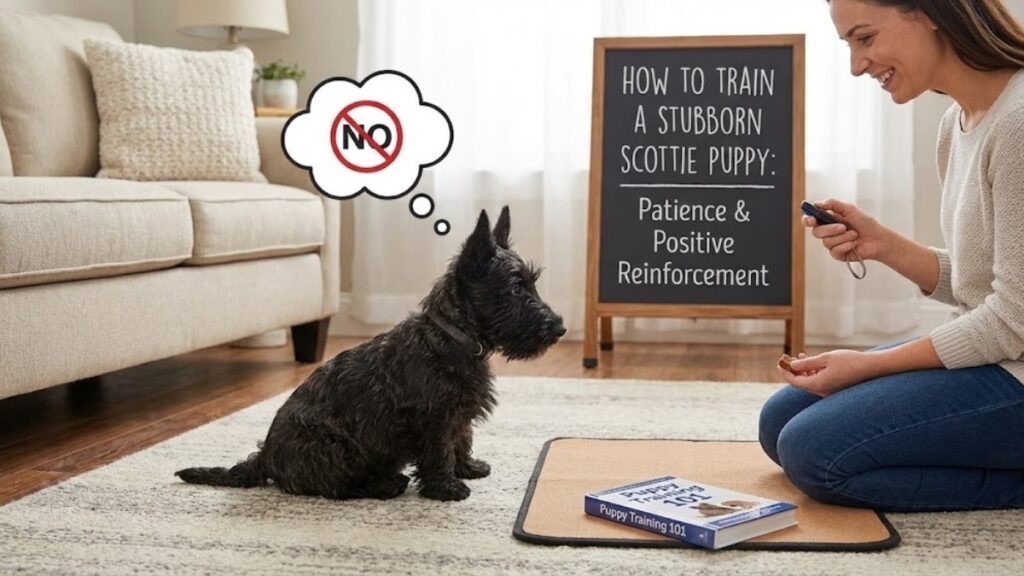
You got a Scottish Terrier puppy. Cute as a button. Stubborn as a mule. Sound familiar? If you’re wondering how to train a stubborn Scottie puppy, you’re in the right place.
If you’re staring at a tiny terrier who wants to do the exact opposite of what you ask, don’t panic. Scotties are sharp, proud, and independent. They make rules for themselves sometimes. But they’re not untrainable. Far from it.
This guide walks you through everything: mindset, setup, step-by-step training, troubleshooting, socializing, and a realistic weekly plan. Short paragraphs. Real talk. A bit of humor. No fluff.
Ready? Let’s get to work.
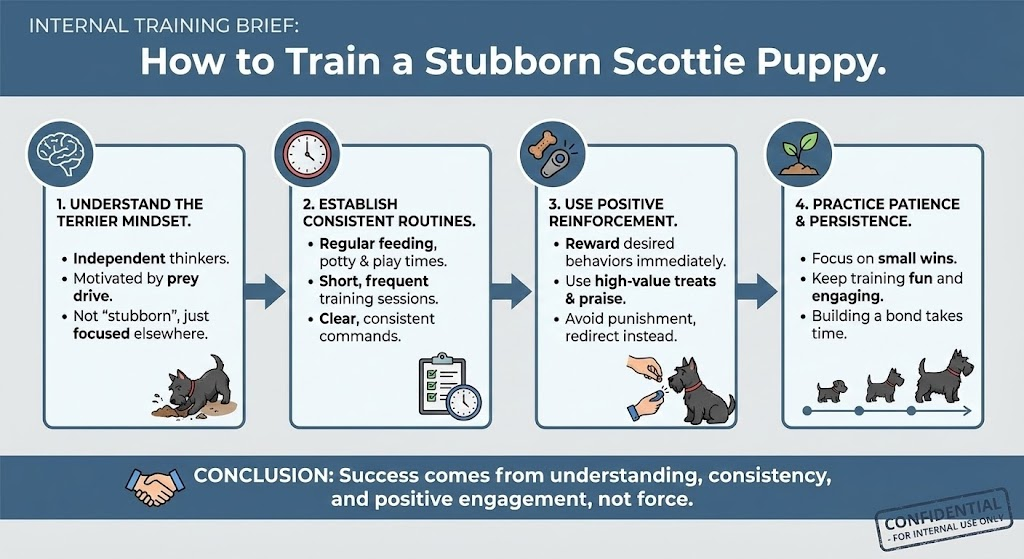
Know Your Scottie: Temperament And Why They Act “Stubborn”
Scottish Terriers were bred to hunt vermin. Small, brave, and used to working alone. That history lives in their brain: they think for themselves. They’re loyal to the core, but they don’t automatically defer to you the way some breeds do.
So what does “stubborn” mean here? It’s a mix of independence plus selective motivation. A Scottie may know a command but choose not to obey because the reward isn’t worth it at that moment. Or they spot a squirrel and suddenly every command gets ignored. Classic terrier move.
Important point: stubborn doesn’t mean dumb. It means you must be smarter about motivation. That’s the whole game.
Get Your Head In The Right Place (Owner Mindset)
This part is huge and often skipped. Training begins with you.
Patience is non-negotiable. Calm energy. Short wins. Consistency.
If you sigh, get loud, or try force, the trust goes out the window and the Scottie digs in deeper. They respond to respect and rewards, not punishment.
Set realistic expectations. Puppies are learning. Scotties often take longer to “get” some commands simply because they weigh the cost/benefit. Give it time. Celebrate tiny victories. One good loose-leash walk? Party for five minutes. That’s progress.
Ask yourself: are you training to control the dog, or to build a partnership? Aim for partnership. Training should be fun for both of you.
Tools & Setup: Make Training Easy To Do Right
You don’t need a closet full of gadgets. You need the right basics.
Essentials
- A gentle harness (no choke chains)
- A 6 to 15 ft long line for recall practice
- High-value treats (small, smelly, soft, tiny pieces)
- A clicker (optional) or a consistent marker word like “Yes”
- Crate and a comfy bed, crate as a safe den, not punishment
- Puzzle toys and durable chews
Training area: low-distraction room to start. Later, graduate to the backyard, then the street, then the park. Puppy-proof the space. Remove tempting shoes, remote controls, anything that will derail a short 5-minute session.
Routine matters. Feed, potty, play, train, nap in a predictable rhythm. Scotties like a schedule more than you would think.
Core Principles That Actually Work With Scotties
Short list, memorize these:
- Positive reinforcement only. No yelling. No intimidation.
- Short sessions: 3 to 10 minutes, 2 to 4 times a day.
- Reward immediately, within one or two seconds.
- Save your best treats for the hardest tasks.
- Consistency across all family members.
- End every session on success.
Why short sessions? Because Scotties have attention spans like tiny CEOs. They decide quickly whether this meeting is worth their time. Keep it snappy. Keep it fun.
How to train a stubborn Scottie puppy
Here’s a quick, practical answer for training a stubborn Scottie puppy:
| Step/Tip | What to Do | Why It Works |
|---|---|---|
| Patience First | Stay calm and consistent | Scotties are independent and strong-willed |
| Use Positive Reinforcement | Reward good behavior with treats, praise, or play. No punishment | Motivates without creating resistance |
| Short, Frequent Sessions | 5–10 minutes, 2–4 times a day. End on a success | Keeps attention, prevents boredom |
| Start With Basics | Name recognition, Sit, Stay, Come, Leave It. Use consistent commands | Builds foundational obedience |
| House Training & Crate | Follow a schedule, reward outdoor elimination, crate as a safe den | Creates routine and safety |
| Leash Training | Teach loose-leash walking using stop-and-start and reward calm walking | Promotes polite walking and control |
| Mental Stimulation | Puzzle toys, scent games, short trick training | Keeps their mind engaged, prevents boredom |
| Socialization | Introduce new people, dogs, environments gradually with rewards | Builds confidence and prevents fear |
| Handle Stubbornness With Fun | Make commands a game, use high-value rewards, avoid power struggles | Encourages cooperation and reduces resistance |
| Seek Professional Help If Needed | Positive-reinforcement trainers help with aggression or severe stubbornness | Ensures safety and expert guidance |
Key Tip: Consistency and rewards beat force every time. Short sessions and fun make training effective.
Step-By-Step Obedience: The Essentials Taught Simply
Below are clear, practical steps for core behaviors.
Name Recognition
Say the pup’s name in a cheerful tone. When they look, reward. Repeat in different rooms. Short and sweet.
Sit
Lure with a treat, move the treat above the nose and back. When the butt hits, click or say “Yes” and reward. Add the word “Sit” once the motion is consistent. Practice in different spots.
Stay
From sit, show your palm and say “Stay.” Step back one step. If they stay, return and reward. Gradually add distance and time. Use a release word like “OK” or “Free.” Always reward the release.
Come (Recall)
Make coming the best thing ever. Start with a long line indoors. Say “Come” in a happy voice, squat, clap, and reward like crazy. Never call them to punish. That destroys trust. Play chase-back games: you run away, real slow, and reward when they catch up.
Leave It / Drop It
Start with a treat in hand. Close your fist around it. When the pup stops trying and looks away, reward with a different treat. Say “Leave It” during the exercise. For “Drop It,” trade an item for a better one.
Loose-Leash Walking
First, let them wear the harness and leash indoors, make it normal. When they pull, stop walking. Stand still. Wait. The moment the leash relaxes, move and reward. Consistency beats force.
House Training & Crate Basics: The Practical Schedule
Scotties can sometimes be slow to potty train. Don’t freak.
Crate training: make the crate cozy. Feed in the crate. Put toys. Let it be a choice, not a jail. Crates help teach bladder control because dogs do not like to soil their den.
Sample puppy rhythm for young pups
- Wake, outside immediately, breakfast, play, short training, potty, nap
- After meals, play, naps: potty
- Every 1 to 2 hours for very young pups
- Night: reduce interruptions gradually
If accidents happen, clean thoroughly with an enzymatic cleaner. No scolding. Figure out what went wrong in the schedule and adjust.
Night routine: quick last potty before bedtime, comfy crate, one short bathroom break early in the night if necessary, then lengthen as the pup matures.
Common Stubborn Behaviors: What To Do When They Dig In
Ignoring Commands
Check: is the reward worth it? Is the environment too distracting? Back up a step. Return to low-distraction practice. Make the command easier, then raise difficulty slowly.
Nipping Or Jumping
For nipping, teach bite inhibition. Yelp-like sound if they bite too hard, then pause play. For jumping, turn away and only reward four feet on the ground. Teach “Off” and reward desired behavior.
Leash Pulling
Use the stop-and-start method. Do not yank. Teach “Let’s go” as the cue for moving forward. Reward for walking beside you.
Excess Barking
Find triggers. Reward quiet behavior with a treat and a calm “Yes.” Teach “Quiet” by rewarding short periods of silence, gradually increasing duration.
Digging
Redirect energy. Create a designated digging patch or sandbox. Reward for digging in that spot. Supervise in the yard.
Resource Guarding
Never punish. Trade up, offer a higher-value item for whatever they are guarding. If it is severe, get a behaviorist.
Socialization & Mental Enrichment: The Smarter The Pup, The Better Behaved
Scotties are bright and love a job. An idle brain becomes a mischief machine.
Socialization: begin early, 3 to 14 weeks is critical, but keep going. People with hats. Kids, gentle. Friendly, vaccinated dogs. Vet handling. Different surfaces and noises.
Go slow. Pair new things with treats and easy wins. Watch stress signs, lip licking, yawning, freeze, and back off when needed.
Mental games
- Puzzle feeders
- Snuffle mats
- Scent trails, hide treats around a room
- Short trick training, roll over, spin, shake, builds confidence
- Quick scent work walks, goal is sniffing, not speed
A mentally tired Scottie is a cooperative Scottie.
Advanced Tips: Make Training Part Of Life
Mix training into daily routines:
- Sit before the bowl goes down
- Wait at the door before going out
- Look or Name for attention before petting
Rotate toys to keep them novel. Use short, fun hurdles or scent-work sessions for energy release. Consider formal positive-reinforcement classes, they offer structure and socialization in one.
Want off-leash eventually? Do not rush. Ensure recall is rock-solid in multiple environments before taking that step.
When To Call A Pro: Signs You Need Outside Help
Most issues you can handle at home. But seek help if:
- Aggression or biting occurs
- Severe fear or reactive behavior
- Resource guarding that escalates
- You have tried consistent, force-free methods for months with no progress
Choose a force-free, certified trainer or an animal behaviorist. Watch them work with other dogs before you commit. Ask for references.
Mistakes Owners Make (And How To Avoid Them)
- Inconsistency across family members. Fix: make a cheat-sheet of commands and rewards
- Repeating commands endlessly without shaping behavior. Fix: reward incremental progress
- Punishment or yelling. Fix: use removal of attention or ignore mild nuisance behavior instead
- Skipping socialization. Fix: small, positive exposures daily
- Expecting instant perfection. Fix: set weekly measurable goals, not unrealistic expectations
Track Progress & Celebrate Wins: Keep Morale High
Training is a marathon, not a sprint. Keep a simple log:
- What you trained, command, duration
- What worked, treats, toys
- What failed and why, distraction, timing
Record short videos. Rewatch them to see subtle improvements. Celebrate small wins. Share funny moments with friends. It keeps you motivated.
Remember, a well-trained Scottie is politely independent, not robotic. That is the sweet spot.
Sample 4-Week Starter Plan (Practical & Realistic)
Week 1: Foundations
- Focus: name, sit, crate, potty schedule
- Sessions: 3 to 5 minutes, 4 times per day. End on success
- Walks: short, on-leash, lots of sniffing
Week 2: Add Recall & Leave It
- Focus: recall on long line indoors, Leave it with low-value items
- Sessions: 5 to 8 minutes, 3 times per day. Short play sessions as rewards
- Socialize: friendly neighbor visits, gentle handling
Week 3: Leash & Stay
- Focus: loose-leash practice in low-distraction area, Stay with small distance
- Sessions: 5 to 10 minutes, 3 times per day. One puzzle toy daily
- Outings: short noisy environment exposure, lots of treats
Week 4: Proofing & Enrichment
- Focus: practice commands in multiple rooms and outside, longer recall distance
- Add scent games and trick training
- Consider a positive-reinforcement puppy class
Adjust the pace to your pup. Some Scotties move faster, others need extra time on each step.
Quick Printable Checklist
Daily
- 3 to 4 short training sessions, 3 to 10 minutes
- Follow potty schedule, every 1 to 2 hours for very young pups
- One mental enrichment activity, puzzle or scent
- One quality social exposure, person, dog, surface
- 15 to 30 minutes supervised play or exercise
Weekly
- Practice commands in new environments
- One grooming handling session: ears, paws, teeth
- Record one training session for review
- Rotate toys and treats for novelty
If stuck
- Reassess reward value
- Reduce distractions and back up a training step
- Consult a positive trainer if aggression or guarding occurs
Final Thoughts: Patience Pays Off
Scotties test boundaries. They will be cute, clever, and infuriating, in equal measure. But that stubborn streak is also what makes them memorable. Treat it as a quirk, not a flaw. Use rewards. Stay consistent. Keep sessions short and joyous. Build trust.
Ask yourself: do you want a dog who follows every command, or a dog who chooses you because they like you? With Scotties, the latter is the realistic and lovely aim.
Start today. Do one short session. Make it fun. Make it count. Then go give your terrier a scrap of something smelly and watch that little tail wag like it is the first day of spring.
Encouraging Words For Owners
Training a Scottie puppy can feel frustrating at times. There will be days when nothing seems to stick. And yes, sometimes you’ll feel like giving up. But remember, each small success is a building block. Every “sit,” every successful recall, every potty done outside is a victory.
Laugh at the mistakes. Celebrate the quirks. Keep your energy positive. A happy, confident Scottie is a cooperative Scottie. And the bond you build through patient training is priceless.
Key Takeaways
- Patience and consistency are everything.
- Positive reinforcement beats force every single time.
- Short, fun sessions work better than long, frustrating ones.
- Socialization and mental enrichment are as important as obedience training.
- Scotties are intelligent, independent, and wonderfully stubborn. Use it to your advantage.
- Seek professional help if needed, but remember, most challenges can be handled at home with the right approach.

Pet trainer with a passion for helping animals and owners build strong, loving bonds through positive reinforcement and expert care.