
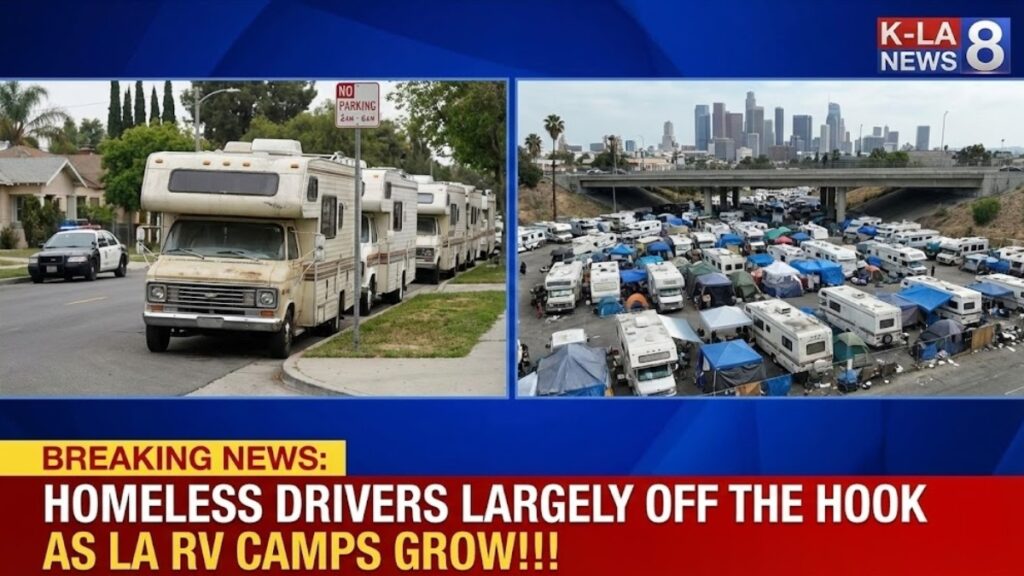
Los Angeles, CA — A new state law and local practices have created significant changes in how California treats parking violations and recreational vehicle (RV) encampments, drawing renewed attention to the homelessness crisis in Los Angeles and broader parts of the state.
Under recently updated rules, cities and parking enforcement bodies now have broader discretion to reduce or waive parking tickets and related penalties for people experiencing homelessness or financial hardship. This includes waiving late fees, freezing penalties while individuals are enrolled in relief programs, and capping monthly payments at low levels.
In some cases, enforcement processes like registration holds at the Department of Motor Vehicles can be lifted simply for enrolling in these programs, even if a ticket was issued years earlier. The goal of these provisions is to prevent individuals from falling deeper into debt and losing vehicles that may serve as their shelter.
However, critics say the policies have inadvertently contributed to a growth in long‑term RV encampments, particularly in Los Angeles neighborhoods, where enforcement remains limited and temporary.
New Law Eases Penalties for Homeless Drivers
The updated legal framework in California explicitly allows cities to consider a driver’s financial hardship or homelessness when issuing or enforcing parking penalties. For drivers classified as indigent, fines and fees can be reduced or even paused while they are in the program, with low monthly payments of around $25 and minimal processing charges.
These changes apply retroactively, meaning individuals can seek relief years after citations were issued. The intentions behind this law are rooted in compassion and reducing unnecessary legal burdens on some of the state’s most vulnerable residents.
However, enforcement critics argue that in practice these provisions have weakened incentives to comply with parking laws and shifted the dynamic on public streets.
Supporters of the law contend that harsh penalties for people already struggling to survive — and who may be living in their vehicles — do little to address root causes like housing shortages, poverty, and systemic inequality. They argue that reducing fines and penalties is a humane response that acknowledges homelessness as a social problem rather than a criminal one.
RV Encampments Spread Across Los Angeles
Across Los Angeles, RVs and other vehicles used as dwelling units have become an increasingly visible part of the homelessness landscape. A growing number of street encampments made up of RVs, vans, and cars have appeared in neighborhoods from East Gardena to Playa del Rey and beyond, prompting concerns from residents, business owners, and local officials about public safety and sanitation. AOL
A long‑time Los Angeles resident told reporters that large clusters of RVs parked along neighborhood streets have created problems with blocked sight lines, trash accumulation, and hazards associated with generators, heaters, and human waste.
In some areas, business owners pointed to increased incidents of theft and illegal dumping tied to encampments. These complaints reflect broader tensions between residents who want stronger enforcement and advocates who stress the need for supportive services and affordable housing.
State and Local Responses to Encampments
The homelessness crisis — including RV encampments — is not simply a local issue. California has expanded state‑level efforts to tackle unsheltered homelessness and improve living conditions for people on the streets.
For example, Governor Gavin Newsom established the SAFE Task Force, a statewide initiative aimed at prioritizing and dismantling unsafe encampments on state‑owned rights‑of‑way while connecting residents to shelter and services.
The task force draws on emergency management, public health, behavioral health, and homelessness services to coordinate approaches in major cities.
Los Angeles County’s Pathway Home program represents a similarly multifaceted effort. It focuses specifically on individuals in RV encampments, pairing outreach with housing transition support. Since its launch, Pathway Home has moved hundreds of people into interim shelter, provided supportive services, and permanently removed many dilapidated vehicles off the streets.
Collaborative efforts between the Los Angeles County departments of health, mental health, public works, and sheriff’s outreach teams have emphasized wrap‑around services — including case management, substance use counseling, and long‑term housing support — for participants.
These programs aim to balance compassion with public safety, helping people transition off the streets while mitigating hazards associated with encampments. Advocates say such efforts lead to more durable solutions than alone penalizing people who have no stable housing options.
Enforcement Challenges and Opposition
While state and county responses target humanitarian solutions, enforcement remains uneven. Local councils in areas like the San Fernando Valley and Venice have moved to ban practices such as “vanlording” — where use of RVs as rental housing in public right‑of‑way is explicitly outlawed — and to restrict leasing of RVs for residential use.
These measures reflect fears that some people are exploiting the system by renting out vehicles on public streets, compounding the homelessness problem.
Neighborhood groups, meanwhile, complain about the long‑term occupation of public streets by RVs and vehicles without regular enforcement, while others highlight uneven application of parking and traffic laws.
A Sherman Oaks homeowner noted that ordinary residents might face strict enforcement for parking violations while RV residents facing similar or more serious violations are given leniency under hardship provisions — raising issues of fairness and public perception.
Progress and Complex Realities
Despite tensions, recent data suggest both challenge and progress coexist. Los Angeles County and the city of Los Angeles continued to report declines in overall street homelessness and encampments, with countywide encampment counts down and comprehensive outreach efforts contributing to reductions. These changes show that strategic investments in housing and services can yield measurable results, even amidst persistent gaps.
Yet many advocates caution that homelessness, especially among vehicle dwellers, is deeply tied to broader economic and housing shortages. With limited affordable housing and transitional support, many people may have little choice but to seek shelter in vehicles — even if that results in complex social challenges.
A Broader Policy Puzzle
California’s approach reflects a broader policy debate about how to balance enforcement, public health and safety, compassion, and housing access. Reducing penalties for homeless drivers aims to reduce punitive cycles that trap people in debt, but critics worry it discourages compliance and enables long‑term street occupancy. At the same time, residents and business owners emphasize the need for orderly streets and safe communities.
The discussion plays out not only on sidewalks and city council floors, but also in the daily lives of tens of thousands of Californians whose housing options are limited by high rents, stagnant wages, and a shortage of affordable units.
In the coming months, lawmakers, local officials, and community groups are expected to revisit enforcement policies, expand supportive housing options, and test new strategies that balance humane care with effective management of public space. How California navigates this challenge in Los Angeles — the state’s most populous city and homeless epicenter — could influence homelessness policy debates across the country.

Pet trainer with a passion for helping animals and owners build strong, loving bonds through positive reinforcement and expert care.