
Washington, D.C.
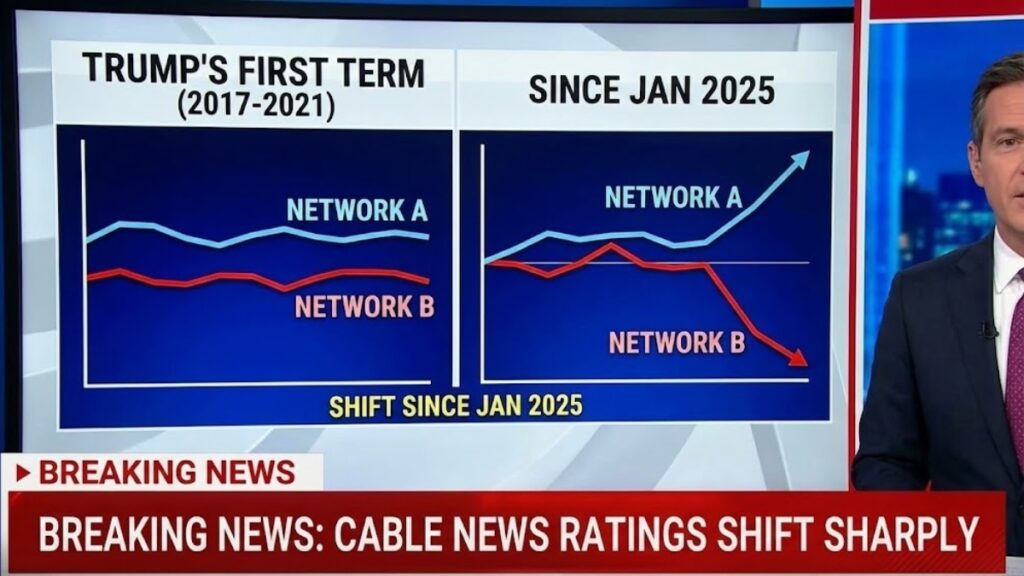
New television rating data and industry observers suggest that the relative audiences for major U.S. cable news channels — particularly CNN and MSNBC — have changed significantly between Donald Trump’s first term in office (2017-2021) and the start of his second presidency, a period some commentators are describing as “Trump 2.0.”
According to ranking summaries circulating on social platforms, networks that once drew viewers with intense coverage of Trump’s presidency are now struggling to retain that same audience share, while rival networks have drawn comparatively stronger viewership.
This shift reflects broader dynamics in the cable news landscape, where political stories, channel strategies, and evolving viewer habits influence who watches what and when.
What the Numbers Show
Social media posts and commentary describe a reversal of viewer patterns compared with the Trump era of 2017-2021. During that earlier period, cable news networks such as CNN and MSNBC enjoyed high ratings — in part driven by continuous coverage of Trump’s policies, controversies, and legal fights, which spiked audience interest. By contrast, in the current period several observers suggest that coverage of Trump’s second presidency has not translated into similar gains for all networks.
Independent ratings data from Nielsen and industry reports help put these broader claims in context:
Fox News remains the dominant cable news channel.
According to Nielsen measures for 2025, Fox News continued to lead cable news in both total viewership and the key Adults 25-54 demographic, outperforming CNN and MSNBC by substantial margins. The network ended 2025 with some of its best non-election year figures ever, averaging around 2.7 million primetime viewers and about 287 000 viewers in the key demo, increases from the prior year. In contrast, MSNBC and CNN both showed declines in viewership and demo audiences.
CNN and MSNBC trailing.
Nielsen data from the same period showed that MSNBC (rebranded by some outlets as “MS NOW”) averaged roughly 923 000 total viewers and about 81 000 in the key demo, while CNN averaged 580 000 total viewers and about 105 000 in the demo. These figures represented year-on-year declines for the two networks.
In the third quarter of 2025, detailed ratings comparisons placed Fox News at the top of cable news, well ahead of its competitors. CNN and MSNBC both registered lower audience numbers, with CNN in fifth place among cable channels and MSNBC also well behind Fox News in total viewers and demo performance.
Why Some Analysts See a Ratings “Flip”
The social posts highlighting a “flip upside down” in ratings are rooted in the observation that CNN and MSNBC once flourished during Trump’s first term — largely because extensive coverage of controversies and investigations drew viewer attention.
During that first term, cable outlets frequently reported on the Mueller investigation, impeachment proceedings, and other high-profile events, and audiences responded with strong tune-in rates.
In contrast, some commentators suggest that Trump’s return to office has not produced the same sustained ratings boost for these networks. Viewership appears to have declined from the highs seen in previous years, even as political events continue to occupy front-burner news coverage.
These critics argue that CNN and MSNBC relied for too long on a narrative of opposition to Trump, and when his return did not create immediate crisis-level viewer demand, their audiences moved elsewhere or tuned out.
Industry Trends and Broader Shifts
Experts point out that ratings patterns are shaped by multiple forces, not just political figures. Some of the larger trends affecting cable news viewership include:
Declining traditional TV audiences:
Overall cable TV audiences have shrunk in recent years as more viewers turn to digital platforms, streaming services, and online clips for news. This affects all linear TV channels, including CNN, MSNBC, and Fox News.
Changing viewer preferences:
Younger audiences are less likely to watch cable news on television, preferring online sources such as social platforms, podcasts, and long-form digital content. Traditional Nielsen ratings do not capture all of these digital views, meaning some outlets’ total reach may be undercounted.
Competitive dynamics:
Fox News’ continued dominance is not only a result of political alignment but also programming strategy. Its primetime lineup consistently ranks at the top of cable news, giving it an edge in cumulative audience metrics.
While Fox continues to build its ratings lead, CNN and MSNBC have experimented with changes such as leadership restructuring and shifts in programming focus. For example, recent industry reports note CNN’s spin-off into a separate broadcast entity in the wake of a large acquisition deal involving its parent company, a move some analysts say is designed to refocus resources and adapt to the evolving media market.
Reactions from Networks and Media Analysts
Leaders from CNN and MSNBC have described efforts to adapt to the changing landscape. Behind the scenes, strategic decisions include adjusting editorial focus, staffing changes, and experimenting with digital subscriber models to complement traditional ratings.
Some media analysts argue that ratings alone present an incomplete picture. Cable networks increasingly judge success not just by Nielsen numbers but by digital engagement, streaming viewership, and social media interactions, which often tell a different story about audience interest. These metrics are particularly relevant for networks trying to attract younger or more diverse viewers.
Others point out that while CNN and MSNBC have lost ground relative to their peaks, they continue to command significant digital audiences and maintain influence among politically engaged viewers. In some election and policy-driven events, these networks still draw substantial viewership spikes, even if average ratings lag behind the highest-rated channels.
Political Context and Viewer Motivation
Political developments inevitably influence news consumption habits. Cable news networks orient much of their programming around political stories, and shifts in public interest can affect ratings.
During Trump’s first administration, controversies and legal battles involving his administration drove heavy news consumption. That period saw frequent spikes in viewership as audiences tuned in for updates on investigations and high-stakes political narratives.
In the current era, although Trump remains a figure of interest, some analysts suggest that political fatigue or a more fractured media ecosystem has blunted the ratings impact that similar stories once had. With so many alternative sources for news — from YouTube to niche news apps — cable news no longer dominates as it did a decade ago.
What Comes Next
As CNN, MSNBC, and Fox News navigate 2026 and beyond, how audiences respond to major news events will continue to shape ratings. Cable news companies will also be assessing how to balance traditional television metrics with digital opportunities.
Fox News’ strong performance highlights that established audience loyalty can sustain viewership even in a changing media world. But CNN and MSNBC’s leadership has emphasized adaptation, including digital expansion and audience engagement beyond linear TV.
Whether these shifts represent a long-term realignment or a temporary phase in the political news cycle remains to be seen. What is clear is that cable news — once dominated by big ratings surges tied to political drama — now faces a more complex environment where digital strategy, platform diversity, and audience fragmentation play central roles in determining success.

Pet trainer with a passion for helping animals and owners build strong, loving bonds through positive reinforcement and expert care.