
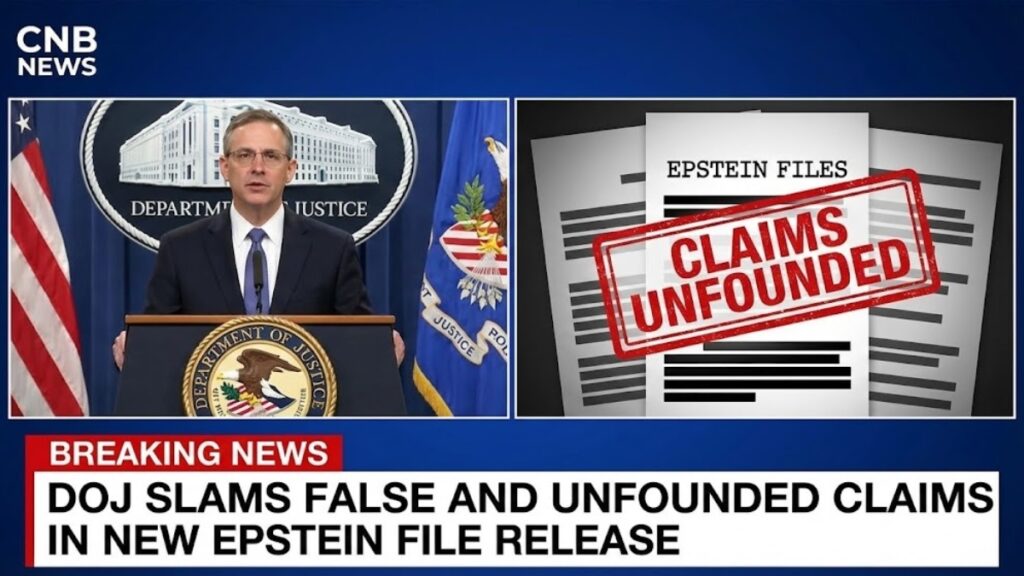
Washington, D.C. In what has become a contentious intersection of government transparency, legal obligation, and political debate, the U.S. Department of Justice has sharply challenged assertions contained in newly released Jeffrey Epstein files that implicate or reference former President Donald Trump. The department called the claims “unfounded and false” even as it released thousands of pages of material under a federal transparency law.
The episode highlights tensions over how sensitive legal documents should be handled, the obligations of government to victims and the public, and the broader political ramifications as the files enter the public domain. Analysts say the controversy illustrates how historical documentation can quickly become a flashpoint in modern political discourse.
Largest Batch of Epstein Files Released Yet
The Justice Department recently released a fresh tranche of documents tied to investigations of Jeffrey Epstein, the financier and convicted sex offender whose criminal network and mysterious death in federal custody in 2019 have fueled decades of news coverage and public intrigue.
This batch, consisting of tens of thousands of pages, represents one of the most significant disclosures since Congress passed the Epstein Files Transparency Act.
The law obligates the DOJ to release unclassified records from its files on Epstein and his long-time associate Ghislaine Maxwell, herself convicted and serving a lengthy prison sentence for her role in the exploitation of minors. Among the released materials are investigative reports, internal communications, subpoenas, and other records that were previously sealed or held in government archives.
Officials have emphasized the scale of the task, noting that the department is reviewing millions of pages and hundreds of thousands of records before they can be made public, a process expected to continue well into the early new year.
DOJ’s Response to Claims in the Files
Shortly after the release, the Justice Department issued an explicit statement on its official social media account and through public statements regarding certain allegations in the files. The department warned that some documents contained “untrue and sensationalist” claims about Trump that had been submitted to the FBI during the 2020 election cycle. It stated that these claims are “unfounded and false” and stressed that if they had any credible basis they “certainly would have been weaponized against President Trump already.”
Among the specific items addressed by the department was a purported handwritten letter, allegedly signed by Epstein and referencing political figures, including a line about “our president.” After examination, the FBI determined that letter was forged, citing inconsistencies in handwriting, the postmark date and location, and other procedural irregularities. The DOJ called the letter fake and clarified it had no authentic connection to Epstein.
Officials have stressed that no credible evidence of wrongdoing by Trump related to Epstein’s criminal network has emerged from the released materials, and that Trump has not been accused of crimes in connection with the files. DOJ spokespeople have framed their approach as one of strict legal compliance, emphasizing the obligation to publish all materials required by law while protecting sensitive victim information.
Legal and Procedural Context
The latest release and the DOJ’s attendant statements occur under a legal framework shaped by both public demand and legislative action. The Epstein Files Transparency Act was enacted to increase public access to records long shielded by grand jury secrecy rules and protective orders. Proponents argued that the public has a legitimate interest in seeing full documentation of investigations into Epstein’s conduct and connections to powerful individuals. Critics, however, warned that indiscriminately releasing raw documents could expose victims, reveal sensitive investigative methods, and circulate unverified claims in a manner that fuels misinformation.
DOJ officials, including Deputy Attorney General Todd Blanche, have described a careful review process involving hundreds of lawyers and analysts working around the clock to redact and release material while minimizing harm to victims and protecting legitimate law enforcement interests.
The department’s official public record on the release also underscores that its systematic review found no basis to revisit or expand the scope of criminal prosecution or to identify a “client list” of individuals targeted for exploitation or blackmail as part of Epstein’s network. The DOJ noted it did not uncover evidence that could justify investigations against previously uncharged individuals.
Reactions from Legal Advocates and Victims
Not everyone has welcomed the DOJ’s handling of the document release. Attorneys representing Epstein’s victims have been outspoken in their criticism, describing the rollout as a “complete mess” and expressing concern that the department’s defensive posture — especially its public comments about claims involving Trump — distracts from the serious nature of the material and could impede justice.
Some advocates argue that releasing unvetted documents without sufficient context invites confusion and misinformation. They say survivors have a right to clarity and that the DOJ’s public disclaimers about certain claims only highlight how poorly contextualized the disclosures can be for the average reader.
Sympathetic observers also raise questions about selective commentary by the department on specific allegations. They argue that contextual explanations were provided only in the case of Trump-related claims, while many other parts of the files remain opaque or unsupported by accompanying clarifications.
Political and Media Impact
The emergence of the Epstein files and the DOJ’s forceful response to certain allegations has quickly entered the wider political arena. Trump and his allies have seized on the DOJ’s dismissal of the claims as further proof that the accusations against him are baseless. They have criticized media coverage that focuses on appearances of his name in the records and have framed the debate as politically motivated.
Opponents, however, argue that even unverified references point to the necessity of robust historical documentation and full transparency. They say the focus should remain on understanding the breadth of Epstein’s network and ensuring accountability for wrongdoing.
Major news outlets and political commentators are weighing in from various perspectives. Some emphasize the need for caution in interpreting raw documents that were not designed for public consumption. Others focus on the political use of the files in ongoing debates about accountability, power, and media narratives.
What the Files Show and Don’t Show
Although public attention has gravitated toward the political implications, experts stress that the bulk of the released materials relate to long-standing criminal investigations. These include court records, interviews, subpoenas, communications involving Epstein’s properties and travel, and documents tied to law enforcement interviews.
Despite the volume of material released so far, experts caution that the contents should not be taken as definitive proof of allegations not backed by verified evidence or formal investigation. The DOJ’s explicit statement about unfounded claims underscores its position that inclusion in the files does not equate to truth.
Broader Implications for Transparency and Justice
The ongoing release of Epstein files has highlighted a broader debate over the balance between transparency and the protection of victims and investigative integrity. Supporters of full disclosure argue that unsealing records is essential to public accountability. Critics counter that raw releases can spread misinformation, jeopardize individuals, and distract from verified legal findings.
Law enforcement officials have reiterated their commitment to continuing the process of reviewing and publishing documents, but they acknowledge the challenges posed by sheer scale, legal constraints, and public expectations.
What Comes Next
The Justice Department plans to continue reviewing and releasing more documents in early 2026, while balancing the need for transparency with legal safeguards. The process, already delayed relative to original deadlines, is expected to unfold over months. Officials have indicated that redactions and privacy protections will remain priorities, even as public pressure for fuller access persists.
Congressional oversight, media scrutiny, and legal advocacy are likely to remain intense as additional materials become available. How the DOJ navigates claims within the documents, and how political actors interpret them, will shape public discourse in the months ahead.
Summary
The Department of Justice has released a significant batch of Epstein-related files, but has publicly rejected certain allegations within them as unfounded and false. The files’ release highlights ongoing tensions between transparency, legal procedure, victim protection, and political interpretation as debate continues over Jeffrey Epstein’s network and its broader implications.

Pet trainer with a passion for helping animals and owners build strong, loving bonds through positive reinforcement and expert care.