

You’re drawn to the beard. Of course you are. That little dignified face that looks like it belongs on an old professor, the proud prance that says “step aside, royalty coming through,” and that unmistakable “I’ve got places to be” walk. A Scottish Terrier is not just a dog, it’s a character straight out of a storybook.
But here’s the truth: when you bring one home, you are not buying a statue carved out of stone, you are inviting a whirlwind of personality into your living room.
These dogs are not quiet ornaments that sit in the corner. They are more like stubborn little generals running patrol in your backyard, with a touch of comedy when the mood strikes.
Which brings us to the real question every curious dog lover asks: Are Scotties good family dogs? Can these bold, mustached little firecrackers settle into the heart of a household, or are they destined to clash with the chaos of family life?
The short answer is yes. They can be wonderful companions for the right people. But they are not every family’s cup of tea.
Think of them like strong coffee. Energizing, bold, and unforgettable, but not for someone who was hoping for chamomile tea.
So let’s break it down, story by story, with real-life experiences, a bit of science, and a clear look at what living with a Scottish Terrier is really like.
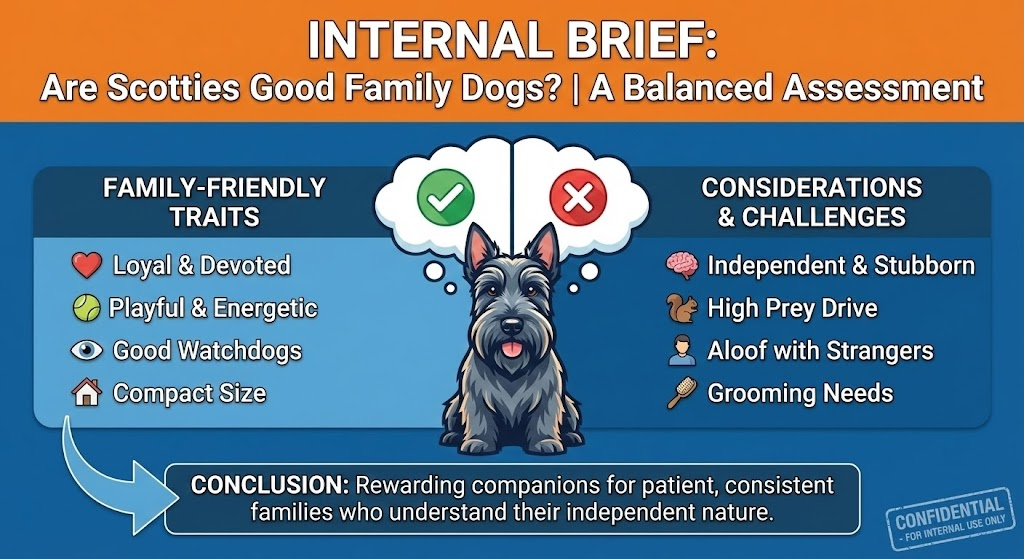
Are Scotties good family dogs?
Are Scotties good family dogs? They can be fiercely loyal companions, full of charm and personality, but they also come with quirks that make family life both delightful and a little unpredictable.
First, the Scottie vibe (a quick reality check)
Scotties are not typical lapdogs. They’re terriers. Bred in Scotland to dig, chase, and hunt vermin in rough country. That history matters. You do not erase centuries of genetics with a squeaky toy and a cuddle blanket.
The American Kennel Club describes Scotties as confident, dignified, and independent — with the official nickname “diehard” (AKC, Scottish Terrier profile). That is not an exaggeration.
Here’s what that looks like in real life: Laura, a client in Boise, brought home Fergus at ten weeks. For three days, he acted like “come” was a foreign language. Completely ignored it.
By day four she cracked the code with freeze-dried salmon. Suddenly Fergus was flying to her knees every time.
Not because he suddenly respected authority, but because Scotties work for what they personally value. That lesson stuck.
That’s Scotties in a nutshell. They love their people, but they are not golden retrievers. They won’t sell their soul for a pat on the head.
Earn their trust and they’ll be loyal as a shadow. Ignore who they are, and they’ll ignore you right back.
Temperament: the good, the quirky, the “oh boy”
Temperament: the good, the quirky, the “oh boy” side of what makes Scotties good family dogs
The good
Devoted guardians. A Scottie will patrol your hallway like the TSA on high alert. In private, they’re clowns. In public, they’re dignified and composed. Families often call them “characters” because they carry themselves like little people in dog suits.
The quirky
Affection is on their terms. One moment they’ll explode in zoomies, the next they’re perched on the sofa like a stone gargoyle, silently judging you.
The “oh boy”
Independence. Tell a Scottie “sit,” and he might tilt his head as if to ask, “Why?” Research comparing breed trainability consistently finds terriers rank high for independence and persistence (Applied Animal Behaviour Science, 2023 review). Translation: Scotties hear you. They’re just not sure you’ve made your case yet.
And honestly? That’s the charm for the right family. If you like a dog with opinions, a Scottie will make you smile. If you crave instant compliance, you’ll be frustrated.
Scotties and kids: sweet or spicy?
This is where families get nervous.
Scotties can be excellent with respectful children, especially school-age kids and up. They will hover near homework time, patrol during sleepovers, and shadow older kids with quiet loyalty.
But toddlers? Different story. Scotties don’t always tolerate beard pulling, ear tugging, or squeals inches from their face.
Take the Johnsons in Boise. Three kids: ages four, seven, and ten. Their Scottie, Mac, adored the ten-year-old. Slept on his bed, followed him to soccer practice. The seven-year-old learned Quickly: gentle touch, ask before petting, treats go far.
The four-year-old, though, grabbed Mac’s beard on day one. Mac air-snapped. No contact, just a warning. It was a scary moment, but also a teaching moment. The family put rules in place: two-finger petting only, no face hugs, and all kid-dog interactions supervised. Within weeks, things smoothed out.
Veterinary guidance echoes this: terriers are not universally patient with very young children. With older kids who can respect space, Scotties thrive (AKC, ASPCA, PetMD).
So ask yourself
- Are your kids old enough to respect boundaries?
- Will you supervise every interaction?
- Can you teach kids to read dog body language (lip licking, stiff posture, whale eye)?
If the answer is yes, Scotties can be a wonderful match. If not, maybe wait a few years.
Other pets: how’s the mix?
Here’s the tough one. Prey drive runs deep. Scotties were literally designed to chase small, fast things.
Some Scotties grow up peacefully with cats. Others never stop hunting them.
In Twin Falls, the Lopez family had two indoor cats and a Scottie pup. They tried everything, from room rotations to scent swaps to leashed parallel play.
Six weeks later, the Scottie was still fixated. The cats were stressed, the pup was frustrated. Eventually they rehomed him to a relative without cats. He thrived there. The cats relaxed. Sometimes love and training cannot override genetics.
With other dogs, it’s mixed. Some Scotties play nicely, especially with mellow retrievers or herding breeds. Others guard toys or act bossy. Slow introductions and clear household rules are essential.
Training and socialization: your lifeline
You don’t dominate a Scottie. You negotiate. Calm, clear, consistent. Reward what you want. Redirect what you don’t.
The ASPCA strongly recommends humane, reward-based training (ASPCA, Training Methods). That’s exactly what works best for Scotties. Use pain or fear and you’ll break trust with a dog who never forgets.
Mia in Meridian learned this the fun way. Her Scottie, Duncan, ignored “sit” for weeks. Then she switched to salmon treats and short, upbeat reps. By week three, Duncan was the teacher’s demo dog in class. At home, puzzle toys and structured routines gave him a job. The digging stopped. The barking eased. Scotties need a job. If you don’t give them one, they’ll invent one.
Practical socialization plan
- Between 8 and 16 weeks: expose to surfaces, people, wheelchairs, hats, strollers. Keep sessions short and positive.
- Teach a reliable “touch” (nose to palm). It becomes your portable recall.
- Manage thresholds. If they look overwhelmed, back off.
If you hire a trainer, vet them like you’d vet a pediatrician. Ask about methods, certifications, and experience with terriers (ASPCA, Behavioral Help Guide).
Exercise and enrichment: smart energy, not endless
Scotties are not marathon runners, but they’re no couch potatoes either. Think bursts of activity.
PetMD notes they need regular walks and daily brain games to stay balanced (PetMD: Caring for a Scottish Terrier).
An Idaho routine that works
- Morning: 20-minute walk with lots of sniffing.
- Afternoon: puzzle feeder or Kong.
- Evening: 25-minute loop plus a few three-minute training bursts.
Skip this and a Scottie will “project manage” your flower beds or redecorate your couch cushions.
Grooming: the beard, the coat, the reality
Yes, the beard is iconic. But it also collects water, crumbs, and spaghetti sauce.
Scotties have a wiry outer coat with a soft undercoat. They shed less than many breeds but not zero. The AKC reminds us: no dog is truly hypoallergenic, though Scotties often suit allergy-sensitive families better (AKC: Hypoallergenic Dogs).
Grooming needs
- Brush weekly.
- Comb furnishings (leg hair and beard) after walks.
- Professional grooming or hand-stripping every 6–8 weeks.
One client learned the hard way. They stretched grooms to 12 weeks. Mats formed, brushing became a battle. We had to reset trust with daily treat-based touch sessions. Lesson: start early, keep it light, keep it consistent.
Health: what you should know before falling in love
Scotties live 11–13 years on average. They’re sturdy, but there are specific risks.
Bladder Cancer (TCC)
Scotties are twenty times more likely to develop transitional cell carcinoma than most breeds (Purdue University, Scottie TCC Risk). Studies also link lawn herbicides and even secondhand smoke to higher risk. Translation: skip broadleaf chemicals if you can, and don’t smoke indoors.
Von Willebrand Disease (vWD)
A hereditary clotting disorder. Breeders can test for it, and they should. UC Davis Veterinary Genetics Lab provides detailed guidance on testing and types.
Scottie Cramp
A quirky neuromuscular condition. Not painful, but causes odd, stiff movements when excited. Many Scotties live normal lives with it. Described in VIN and MSD Veterinary Manual.
Family takeaway: Budget for health screening, keep weight lean, minimize chemical exposures, and partner with a vet who knows terriers.
Life in Idaho (or anywhere like it)
Idaho families ask me a lot: does the climate work? The short answer is yes, but like with any dog, there are adjustments. Scotties are hardy little terriers, built to handle rough ground and shifting weather. Still, the four distinct seasons in Idaho bring both joys and challenges.
Winter
Ice clings to their iconic beards. After a snowy walk, Maggie from Coeur d’Alene often comes back with icicles hanging from her face.
A towel by the door saves your floors and keeps the dog comfortable. Salt on sidewalks can sting paws, so booties or paw balm help.
Despite the cold, Scotties often love winter. Nose down in the snow, digging for “hidden” treasures only they seem to sense.
Spring
Green lawns return, but so do fertilizer and pesticide treatments. Scotties, being close to the ground and prone to sniffing, can pick up residue easily.
Vets often remind families that exposure to lawn chemicals may increase cancer risks in terriers, so being cautious pays off. Mud season also means you will be rinsing paws often. A shallow tub or paw-wash station by the entryway is worth the investment.
Summer
Hot sidewalks can burn paws quickly, and Idaho’s mountain sun gets strong. Early morning and evening walks are safest. Burrs and foxtails love Scottie coats. They wedge into beards, legs, and paws. Post-walk checks become part of the ritual.
Fall
Crisp air, crunchy leaves, and endless sniffing opportunities. This is often a Scottie’s happiest season, with fewer pests and perfect walking weather.
The Parkers in Coeur d’Alene are a great example. Retired, steady routine, fenced yard, daily lakeside strolls, their Scottie Maggie is thriving. Predictability, gentle handling, and a towel by the door are her sweet spot.
And what if you live in a Boise apartment? It works fine if you commit to structured walks, enrichment games, and maybe weekend park visits. Suburban yard? Easier, but do not rely on it alone. Scotties need brain work, not just space.
What Scottie life feels like
Living with a Scottie is like sharing your home with a small, opinionated roommate. They’re not background pets. They are present, observant, and have rituals you’ll soon come to recognize.
Morning
A nose nudges your calf, breakfast is requested. On the walk, he scans the horizon like a mall cop on patrol. He will pause and give you a sharp look if something seems off. Back home, while you sip coffee, he works his snuffle mat with single-minded determination. You can almost see the satisfaction in his eyes when he finds his last kibble.
Midday
While you work, he positions himself where sunlight hits the floor. Half-asleep, half-alert, ears twitching at faint noises. Every so often, he gets up to check the door, then sighs deeply and flops back down
Evening
This is his prime time. On a walk, he stops stubbornly at the corner, nose twitching at a scent only he knows. Inside, zoomies erupt without warning, sudden bursts of speed across the living room, paws clicking against the floor. Minutes later, he is out cold, asleep near you. Always facing the door, because in his mind, guarding is not optional.
That’s Scottie life: structured, quirky, protective, and endlessly watchable.
Frequently Asked Questions
Everything you wonder about Scotties, answered simply.
Are Scotties aggressive?
Not generally, but they are territorial. Think of them as neighborhood security, not street fighters. Socialize early, introduce them to guests properly, and set rules.
Do they bark a lot?
Moderate. They’re alert barkers, not endless yappers. They’ll announce the mailman but usually quiet down if you acknowledge them and use a “quiet” cue consistently.
Are they good first dogs?
Maybe. If you are committed to training, structure, and patience, yes. If you want a dog who instantly obeys without question, probably not. Scotties test limits, but they respect fairness.
Are they cuddly?
Sometimes. On their terms. A Scottie may sit nearby, leaning against your leg instead of climbing into your lap. Respect earns affection, not forcing it.
Can they live in apartments?
Yes, with daily walks and brain games. Many urban Scotties thrive with puzzle toys, scent games, and weekend dog-park visits.
Are they hypoallergenic?
No dog truly is. But their wiry, low-shed coat can be easier for some allergy-prone families. Regular grooming helps.
Do they get along with cats?
Sometimes. But prey drive is real. If your cat runs, a Scottie may chase. Success depends on the individual dog and structured introductions.
How much exercise?
Around 45 to 60 minutes daily, in short bursts. Mental exercise is just as important as physical. Hide treats, rotate toys, teach tricks.
What screenings to ask breeders about?
vWD testing (Von Willebrand’s Disease), cancer awareness, and family health history. Ask about lifespan in their lines. Some live more than 12 years with good genetics and care.
Quick case studies
Glimpses into real families living with Scotties, showing the joys, challenges, and surprising lessons that come with these bold little dogs
Boundaries = Freedom
Two kids, a calm household, clear rules. Their Scottie thrives. Escorts kids to the bus, naps at their feet while they do homework, then proudly patrols the yard. The consistency helps him shine.
Chaos mismatch
Toddler, cat, constant visitors. Their Scottie tried to control everything — barking, herding, guarding. Too stressful for him and for them. Eventually, they rehomed him to relatives with a quieter setup. He’s calmer now.
Perfect golden years
Retired couple, steady rhythm. Their Scottie fits like a puzzle piece. Predictability is everything. He wakes, eats, and strolls with them like clockwork. Both sides feel secure.
Decision tree (gut check)
Think of this like a quick quiz for your lifestyle and personality match with a Scottie.
Do you like a dog with opinions?
Then yes. Scotties are not yes-men. They negotiate, bargain, and sometimes test boundaries. If you like a little back-and-forth, almost like living with a witty roommate, you will love it. If you need blind obedience, you will be frustrated.
Will you train early and kindly?
Then yes. Scotties respond to fair leadership, not harshness. Gentle consistency works. If you’re ready to put in the time with puppy classes, daily reinforcement, and boundaries, you’ll raise a terrific companion. If you delay or let rules slide, you’ll see stubbornness take root.
Do you have toddlers?
Maybe wait. Scotties aren’t always patient with unpredictable little hands pulling fur or startling them. Some families do fine if kids are older (six and up), calmer, and respect rules. But if your household is in constant chaos, it’s a recipe for stress on both sides.
Do you have prey-like pets?
Probably not. Rabbits, hamsters, guinea pigs, or a high-strung cat may not be safe. Some Scotties can learn to coexist, but instinct runs deep. If you’re honest about it, you’ll save heartache later.
Can you budget for grooming, training, and vet care?
Then yes. Grooming is not just brushing. It is hand-stripping or regular trims every 6 to 8 weeks. Training classes, enrichment toys, and potential vet bills, as cancer is a concern in the breed, add up. If you plan for it now, the costs will not catch you off guard.
If you can answer yes to most of these, and if your lifestyle leans toward structure more than chaos, a Scottie could very well be your match.
Balanced verdict
Scotties can be wonderful family dogs for the right family. They are loyal, watchful, hilarious, low-shed, and deeply devoted once you earn their trust. They will stand guard at your front door like a little knight, follow you from room to room just to be near, and give you moments of unexpected comedy with their zoomies and stubborn pauses.
But they are not blank slates. If you want a dog that melts instantly into whatever shape your life is in, you will struggle. Toddler chaos, constant guests, and prey-pet households are hard settings for Scotties. That is not a flaw. It is simply a matter of fit.
They are a breed that rewards the family who leans into structure, clear communication, and respect. Think less “automatic pleaser” and more “small dignitary who becomes family once you prove yourself.”
What I’d tell you if you were my client
If you were sitting across from me, this is the advice I’d give you before you make your final choice:
Meet at least two adult Scotties before deciding.
Puppies are easy to fall in love with, but adults show you the true temperament you’ll live with for 10–14 years.
Talk to breeders about health testing.
Ask directly about vWD, cancer history, and longevity in their lines. A reputable breeder won’t dodge those questions.
Price out grooming and training now.
Find a groomer comfortable with Scottie coats, and ask what it costs. Add up training class fees. If the numbers scare you, better to know before, not after.
Post family rules on the fridge
Things like: “We don’t feed from the table. We give space when the dog is in his bed. We say hello calmly.” Scotties thrive when everyone is consistent.
If you live in Idaho (or similar climates)
- Keep a towel by the door in winter.
- Do burr checks after summer walks.
- Avoid lawn herbicides in spring.
If you commit to these simple steps, you are not just preparing for a pet, you are preparing for a strong, trusting relationship that will last a decade or more.
Pros and cons at a glance
A clear snapshot of what life is really like with a Scottie, from their heart-melting loyalty and playful quirks to the challenges of grooming, training, and managing their strong-willed personality
Why families love them
- Fiercely loyal companions who stick close and watch over you.
- Small watchdogs without drool or overwhelming size.
- Lower shedding compared to many breeds, easier for some allergy families.
- Big personality in a small body, witty, proud, occasionally silly, and always entertaining.
Why some families struggle
- Stubborn streaks that frustrate first-time dog owners expecting obedience.
- Prey drive that makes coexistence with small pets tricky.
- Grooming demands are not just brushing, but also stripping or professional clipping.
- Health risks include notable concerns such as cancer and bleeding disorders, which can make vet bills higher.
Seeing both sides clearly helps you make a choice that feels confident, not impulsive.
Final word
If you want a dog that folds instantly, tail-wagging at every command, a Scottie is not it. If you want a character, a small, noble soul who negotiates with you, guards your door like it is Buckingham Palace, and makes you laugh daily with their quirks, a Scottie might be exactly the right choice.
Be honest about your season of life. Respect who they are, not who you want them to be. Train with kindness, keep that beard clean, and accept that you are bringing in not just a pet, but a personality.
Do that, and you will discover a very particular kind of love, a Scottie’s love. Steady, loyal, protective, and laced with humor.
If that sounds like your kind of home, then yes. Scotties can be amazing family dogs.

Pet trainer with a passion for helping animals and owners build strong, loving bonds through positive reinforcement and expert care.